Fred & Great Art Gallery
GABRIEL - Livia
GABRIEL - Livia
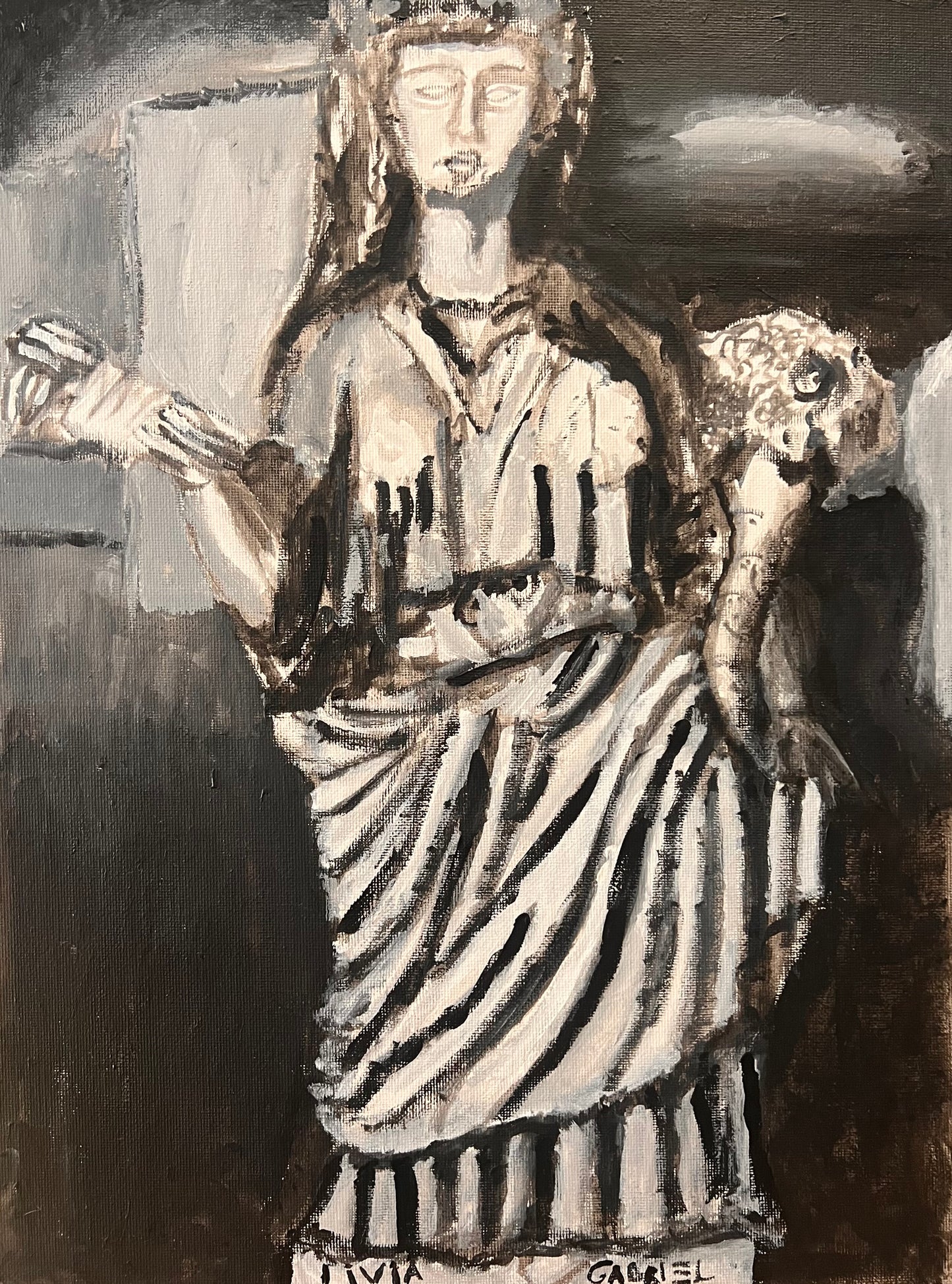
🇬🇧 With this reinterpretation inspired by a photographic image of the Roman statue of Livia, GABRIEL engages in a dialogue not only with classical antiquity, but with the enduring visual authority of sculptural representation.
Rather than seeking archaeological precision or faithful academic reproduction, the artist translates sculpture into painting through a language of expressive simplification. The imperial figure is preserved in her solemn verticality and symbolic dignity, yet transformed by the immediacy of gesture and painterly interpretation.
The restrained chromatic palette — composed of blacks, whites and greys — reinforces the mineral memory of stone while simultaneously shifting the work into a contemporary pictorial register. Light no longer describes marble with precision; it becomes emotional atmosphere.
The folds of the drapery, treated through rhythmic black accents and expressive contrast, no longer function solely as sculptural detail but as autonomous graphic structure. The figure oscillates between monument and apparition.
One perceives in this work less a reproduction than an exercise in translation: the passage from sculpture to painting, from volume to gesture, from historical object to contemporary interpretation. Through this process, GABRIEL transforms classical imagery into a living visual language.
This work reveals an early understanding that art history may be approached not through passive imitation, but through active reinterpretation — where learning becomes a form of reinvention.
🇫🇷 Avec cette réinterprétation inspirée d’une image photographique de la statue romaine de Livie, GABRIEL engage un dialogue non seulement avec l’Antiquité classique, mais avec l’autorité visuelle durable de la représentation sculpturale.
Loin de rechercher la précision archéologique ou la reproduction académique fidèle, l’artiste traduit la sculpture en peinture à travers un langage de simplification expressive. La figure impériale conserve sa verticalité solennelle et sa dignité symbolique, tout en étant transformée par l’immédiateté du geste pictural.
La palette volontairement restreinte — noirs, blancs et gris — convoque la mémoire minérale de la pierre tout en inscrivant l’œuvre dans un registre pictural contemporain. La lumière ne décrit plus le marbre avec exactitude : elle devient atmosphère émotionnelle.
Les plis du drapé, traités par accents noirs rythmiques et contrastes expressifs, cessent d’être de simples détails sculpturaux pour devenir une structure graphique autonome. La figure oscille entre monument et apparition.
On perçoit ici moins une reproduction qu’un exercice de traduction : le passage de la sculpture à la peinture, du volume au geste, de l’objet historique à l’interprétation contemporaine. GABRIEL transforme ainsi l’imagerie classique en langage vivant.
Cette œuvre révèle une compréhension précoce de l’histoire de l’art comme terrain actif de réinvention plutôt que simple imitation.
🇮🇹 Con questa reinterpretazione ispirata a un’immagine fotografica della statua romana di Livia, GABRIEL entra in dialogo non solo con l’antichità classica, ma con l’autorità visiva duratura della rappresentazione scultorea.
Lontano dalla precisione archeologica o dalla fedele riproduzione accademica, l’artista traduce la scultura in pittura attraverso un linguaggio di semplificazione espressiva. La figura imperiale conserva la sua verticalità solenne e la sua dignità simbolica, ma viene trasformata dall’immediatezza del gesto pittorico.
La palette ridotta — neri, bianchi e grigi — richiama la memoria minerale della pietra pur collocando l’opera in un registro contemporaneo. La luce non descrive più il marmo con precisione, ma diventa atmosfera emotiva.
Le pieghe del drappeggio, trattate con accenti neri ritmici e contrasti espressivi, smettono di essere semplici dettagli scultorei per diventare struttura grafica autonoma. La figura oscilla tra monumento e apparizione.
Più che una riproduzione, quest’opera appare come un esercizio di traduzione: dalla scultura alla pittura, dal volume al gesto, dall’oggetto storico all’interpretazione contemporanea. GABRIEL trasforma così l’immaginario classico in linguaggio visivo vivente.